
New UH study: It’s never too late to eat smarter to help your brain avoid dementia
UH Cancer Center researchers help display benefits of MIND diet
June 24, 2025
A new study finds that people who followed a dietary pattern known as the MIND diet were significantly less likely to develop Alzheimer’s disease or related forms of dementia. Even making brain-healthy food choices later in life can help protect against dementia, says the study, which features four University of Hawaiʻi Cancer Center researchers among its authors and is based on data from the Multiethnic Cohort (MEC), a landmark study co-led by the UH Cancer Center.

License: Public Domain
Credit: Dr. Unhee Lim, Professor (Researcher), Population Sciences in the Pacific Program (Cancer Epidemiology), University of Hawaiʻi Cancer Center
License: Public Domain
Credit: Dr. Unhee Lim, Professor (Researcher), Population Sciences in the Pacific Program (Cancer Epidemiology), University of Hawaiʻi Cancer Center
The new study, “The MIND Diet and Incidence of Alzheimer's Disease and Related Dementias Among Five Racial and Ethnic Groups in the Multiethnic Cohort Study,” outlines benefits of the MIND diet. The acronym stands for Mediterranean-DASH Intervention for Neurodegenerative Delay. The diet pattern combines the Mediterranean diet with the blood pressure-lowering DASH (Dietary Approaches to Stop Hypertension) diet, and also emphasizes proven brain-healthy foods like leafy green vegetables, berries, nuts and olive oil. The release of the findings coincide with the June observance of Alzheimer’s & Brain Awareness Month.
The study finds that the MIND diet had a stronger and more consistent risk reduction relationship with dementia than other healthy diets, although the relationship varied among five racial groups. Those who improved their adherence to the diet the most over time showed the greatest pattern of risk reduction. This beneficial relationship was seen similarly among younger and older groups, suggesting that there are benefits to adopting the diet at any age.

“Our study findings confirm that healthy dietary patterns in mid to late life and their improvement over time may prevent Alzheimer’s and related dementias,” said Song-Yi Park, PhD, a Professor in the Population Sciences in the Pacific Program of the UH Cancer Center, and presenting author of the study.
The results also showed that people who improved their adherence to MIND over 10 years (including those who didn’t follow the diet closely at first) had a 25% lower risk of dementia compared to those whose adherence declined. This trend was consistent across different ages and racial groups.
“The take-home message is encouraging,” said Park. “It’s never too late to make changes. Eating more plant-based, nutrient-rich foods — even later in life — can protect your brain.”
Park presented the findings at NUTRITION 2025, the flagship annual meeting of the American Society for Nutrition held May 31–June 3 in Orlando, Florida. Authors of the study also included three additional researchers from UH Cancer Center — Lynne R. Wilkens, Loїc Le Marchand and Unhee Lim — and four others from the University of Southern California, and Pacific Health Research and Education Institute.

“This study highlights the power of large datasets and research generated by our University of Hawaiʻi Cancer Center researchers, such as the Multiethnic Cohort (MEC), and illustrates their global relevance,” said UH Cancer Center Director Dr. Naoto T. Ueno. “As the rate of Alzheimer’s and related dementias climbs — especially in aging populations like Hawaiʻi’s — these findings offer guidance and hope.”
The MIND diet researchers analyzed data from nearly 93,000 U.S. adults who provided information about their diet as part of a research cohort known as the Multiethnic Cohort Study, begun in the 1990s and co-led by researchers from the UH Cancer Center and USC Norris Cancer Center. Participants were between 45-75 years old at baseline, and over 21,000 developed Alzheimer’s or related dementias in the years that followed. The Multiethnic Cohort is the most ethnically diverse epidemiologic study in the world that investigates the roles of lifestyle, diet and genetics in cancer and other chronic diseases.
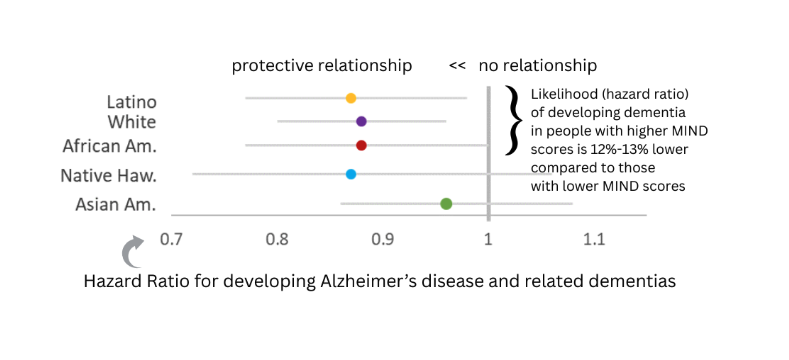
Overall, participants who scored higher for MIND adherence at baseline had a 9% lower risk of dementia, with an even greater reduction — around 13% — among those who identified as African American, Latino or White. Baseline MIND diet adherence was not associated with a significant risk reduction among Native Hawaiian or Asian American participants.
“We found that the protective relationship between a healthy diet and dementia was more pronounced among African Americans, Latinos and Whites, while it was not as apparent among Asian Americans and showed a weaker trend in Native Hawaiians,” said Park. “A tailored approach may be needed when evaluating different subpopulations’ diet quality.”
Researchers said that differences in dietary patterns and preferences among racial and ethnic groups could play a role in the variation they observed in the dementia-diet relationship. Since Asian Americans also experience lower rates of dementia than other groups, it is possible that the MIND diet may not reflect the advantages of diets that are more common among this population. Park said that further studies could help to clarify these patterns and added that interventional studies would be needed to verify cause and effect since the study was based on observational data.
