Daily recap from 17th Annual Weinman Symposium — Spotlight on BAP1 and mesothelioma
January 2026
Editor’s note:
During the 17th Annual Weinman Symposium (WeinmanSymposium.com), Jan. 21-23, 2026, University of Hawaiʻi Cancer Center Scientific Editor Mark Willingham, Jr., is writing a daily report on some key takeaways.
Day 1: Sessions on MicroRNA and Cancer, and Mechanisms
The prestigious 17 th Annual Barry & Virginia Weinman Symposium kicked off on Wednesday, January 23, 2026, at the University of Hawaiʻi Cancer Center. This year’s symposium features 27 presentations by top cancer researchers hailing from across the U.S., Asia and Europe. The late Barry and Virginia Weinman, strong supporters of medical science and education at UH, created the Weinman Foundation Fund for Innovation in 2010 with a gift of a $1.7 million fund to the UH Cancer Center. The annual Weinman Symposium was established with this generous gift, with a goal to bring together international experts from different fields of science and medicine to promote collaboration and brainstorming about specific themes in cancer research.
The 17th Annual Weinman Symposium focuses on BAP1 and mesothelioma. Its renowned slate of guest speakers and experts are leaders in mechanisms of cancer development, cancer research, and genetic syndromes. Admission to the Weinman Symposium is free and open to the public, and high school and college students who are interested in science are especially encouraged to attend.
Day 1 presentations were organized in two major sessions: MicroRNA and Cancer, and Mechanisms. Wiley Advanced Science representation spoke after the introduction as a sponsor of the symposium. Wiley Advanced Portfolio has been a trusted journal home for research for decades because of partnerships between the editors and researchers at every stage of publishing with their 25+ journals.
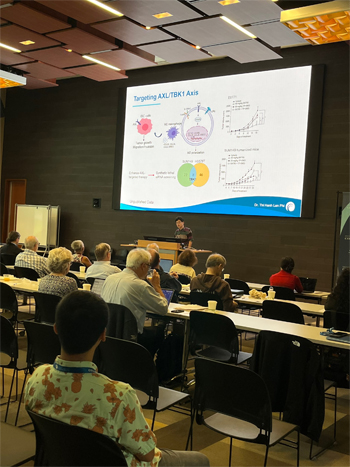
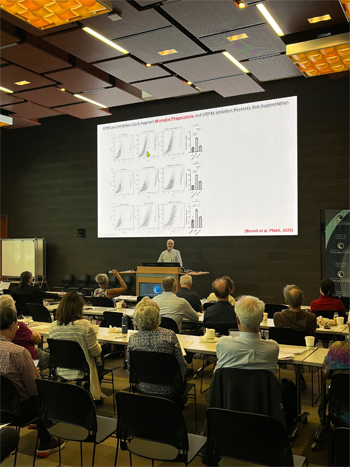
Among the presentations on Day 1, Dr. William Foulkes, Professor in the Department of Medicine, Division of Oncology and Human Genetics at McGill University in Montreal, gave a presentation titled, “DICER1 Tumor Predisposition Syndrome.” Dr. Foulkes highlighted and summarized some of the features of DICER1 and miRNA biogenesis within genes and gene expression. Dr. Foulkes demonstrated how hotspot missense variants in DICER1 rewire the miRNA program, leading to dysregulation of key pathways. These changes could be key early events that lead to tumorigenesis, or the process where normal cells transform into cancer cells.
In another presentation, Dr. Frank Slack, Shields Warren Mallinckrodt Professor in the Department of Pathology and Director of the Institute for RNA Medicine at Beth Israel Deaconess Medical Center in Boston, spoke on “Towards microRNA-based medicine in cancer,” highlighting how MicroRNA will be useful in research of multi- dimensional diseases such as cancer, and how it has been used within clinical trials. Dr. Slack’s spotlighted work demonstrated how he and his team created a comprehensive model of liver disease and hepatocellular carcinoma. Within his work, the loss of miR-21 is shown to be sufficient to cause liver injury, hepatomegaly, hyperglycemia, insulin resistance, steatosis and fibrosis. Restoring miR-32 levels slows down the progression of liver disease and hepatocellular carcinoma, thus indicating a means to manipulate microRNAs and use them as therapeutics within cancer.
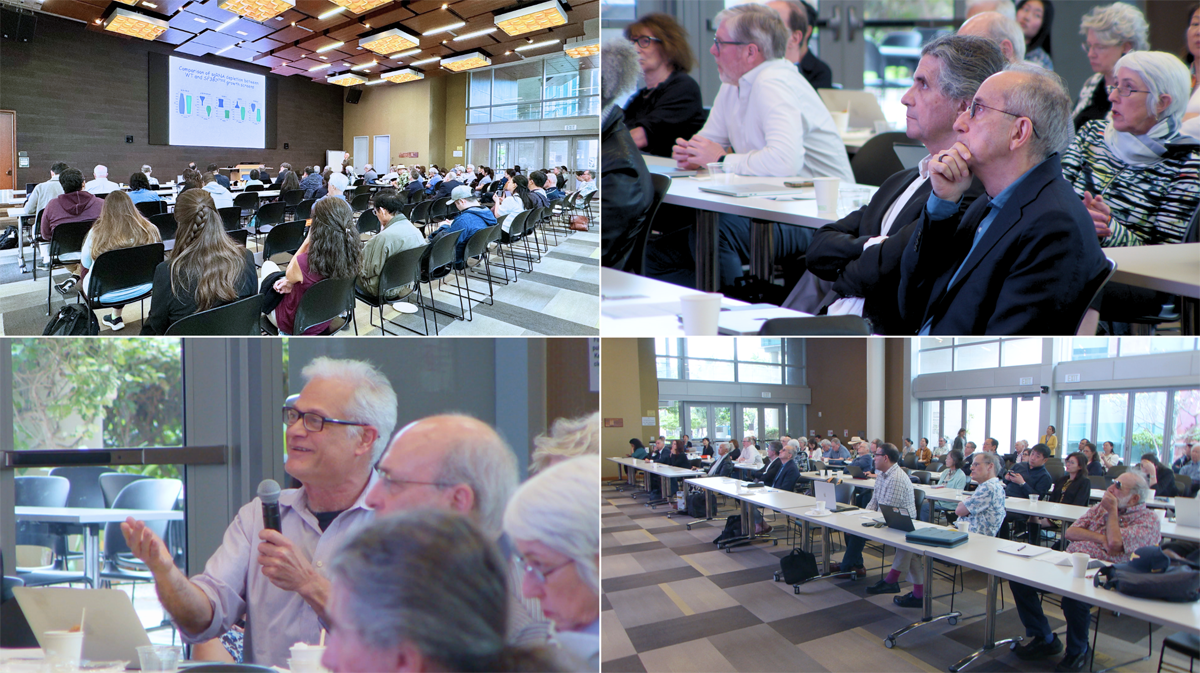
Symposium attendees used these and other symposium talks to ask questions, provide insight, and create network and collaborative opportunities to further the advancement of cancer research.
Day 2: Sessions on Clinical Translational Session, and New Horizons in Cancer Research
The 17th Annual Barry & Virginia Weinman Symposium continued on Thursday, January 22, 2026, with Day 2 presentations organized in two major sessions: Clinical Translation Session, and New Horizons in Cancer Research.
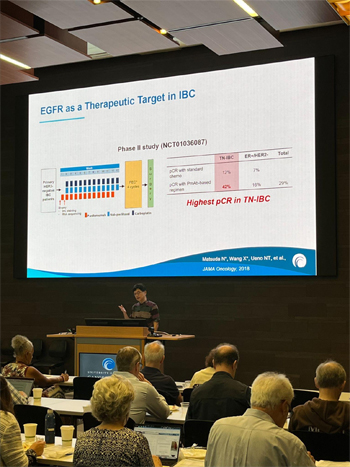
Among the highlights: Dr. Naoto T. Ueno, Director of the University of Hawaiʻi Cancer Center, jumpstarted Day 2 sessions with his talk on “Inflammatory Breast Cancer: An Aggressive Disease Requiring Innovative Solutions.” Inflammatory breast cancer, or IBC, is a rare fast-growing type of breast cancer in which cancer cells block lymph vessels in the skin of the breast, causing the breast to look swollen or inflamed. Dr. Ueno discussed the need to know more about it because the disease is often misdiagnosed. He said the inflammatory breast cancer subtype is the most aggressive breast cancer, accounting for 2-4% of breast cancers in the U.S., but around 10% of breast-cancer deaths in the U.S. Dr. Ueno provided insight into how this type of breast cancer is often misdiagnosed, with its symptoms ignored: The skin around the breast may appear pink or reddish, with pain or itchiness; or breast swelling. Additionally, IBC may not be seen on a mammogram. Dr. Ueno summarized how genomic drivers of IBC have not been identified, as well as examples of potential blood-based biomarkers and novel therapeutic targets for IBC. Dr. Ueno used the symposium opportunity to request collaboration and partnerships to address this rare breast cancer.
Dr. Alan D’Andrea, who is a Alvan T. and Viola D. Fuller American Cancer Society Professor of Radiation Oncology at Harvard Medical School, spoke about “Synthetic Lethality Opportunities for DNA Repair.” Dr. D'Andrea began his presentation with an overview of the six major DNA repair pathways in human cells, and how each pathway repairs a different type of lesion and has an associated human genetic disease. Furthermore, cancer cells are often defective in one DNA repair pathway, and the specific pathway lost may help determine the best course of chemotherapy and radiation for cancer-based precision medicine. Dr. D'Andrea provided insight into Ewing Sarcoma cells and EWSR1 as a critical splicing factor that promotes the faithful splicing of the POLQ pre-mRNA, and how it can interact with other splicing factors.
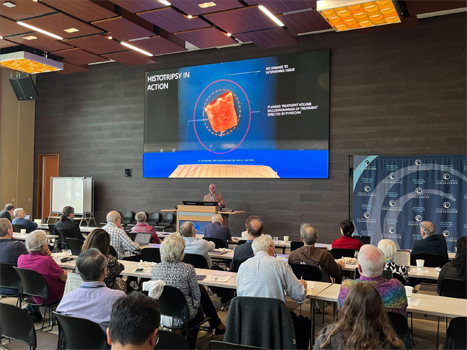
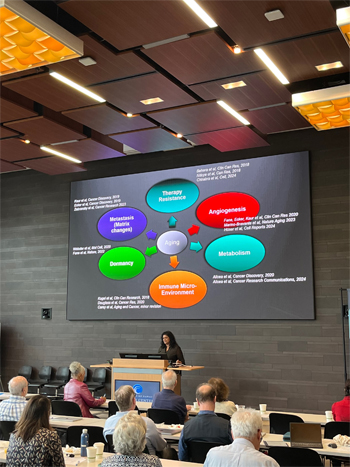
The second section of presentations of the day highlighted New Horizons in Cancer Research. Among the presentations: Dr. Ashani Weeraratna supplied a better understanding of how melanoma is metastasizing across aging, and how aging drives changes in tumor progression. Dr. Christos Galanopoulos demonstrated treatment of liver tumors utilizing Histotripsy, a novel form of focused ultrasound that is designed to mechanically destroy and liquefy targeted liver tumors. This non-invasive treatment works around and destroys the tumor cells, not the tissue.
Audience members continued to ask the speakers questions and provided their expertise to help drive the science presented in the symposium forward through dialogue and collaboration.